
The relief we described two weeks ago as provisional has been revoked. A hotter October inflation report pushed the 10-Year Treasury from 4.84% on November 5 to 5.15% at the November 13 close and moved a December rate hike to near certainty. Fixed-rate debt again costs what it did in mid-October, and floating-rate debt is set to cost more from here. The tension this edition resolves is that lenders are competing harder than at any point this cycle for the strongest loans while rationing credit to nearly everything else. The market is crowded at the top and thin at the margin.
Executive Summary
Relief Revoked: Fixed-rate indications moved roughly 13 to 16 bps higher since our November 2 edition, entirely through benchmarks rather than spreads.
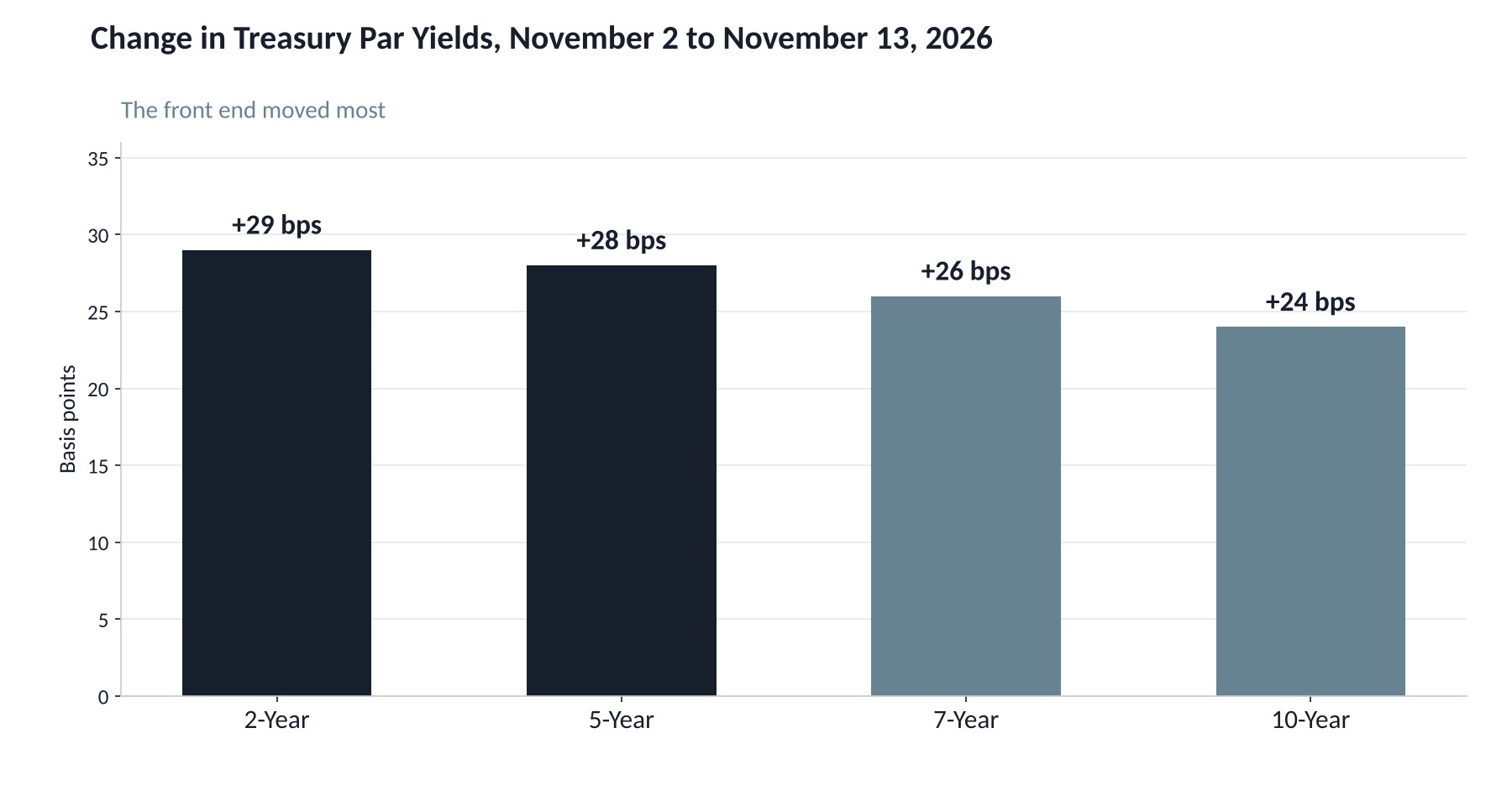
The Front End Now Leads: The 2-Year and 5-Year Treasuries each rose more than 25 bps from November 2 to November 13, and SOFR futures imply a rate near 4.8% by late 2027, against 3.90% today.
Clean Credit Commands Record Spreads: Life company quoted spreads sit at record lows outside of office, and fixed-rate commercial spreads averaged 197 bps in the third quarter, 23 bps tighter than a year earlier.
The Margin Is Tightening: Banks tightened standards in every CRE category, BBB- conduit spreads widened to roughly 540 bps, and brokers report two or three bids per loan where five or six were common.
Distress Is Rotating: CMBS special servicing reached 11.74% in October, a 13-year high, led by lodging and multifamily, and lenders are less willing to extend.
Securitization Has Split: CRE CLO issuance reached $39 billion through October, up 54% from the same period of 2025, while October conduit issuance fell to $1.6 billion from $6.5 billion.
Macro & Monetary Policy Context
The Federal Reserve under Chair Kevin Warsh raised rates 25 bps in September and held at 3.75% to 4.00% on October 28, with two dissents in favor of another hike. The statement described inflation as “elevated” and pledged that the Committee “will deliver price stability.”
October data settled the question. Core CPI rose 0.3% and headline rose 0.4% for the month, both above consensus, and producer prices ran 6.5% above their level of a year ago. By November 16, futures priced better than 90% odds of a 25 bp hike at the December 8 and 9 meeting.
The midterm result produced a one-week countertrend, pulling the 10-Year below 4.85% on lower fiscal expansion expectations. A soft 10-Year auction on November 10 and the inflation data reversed it. A continuing resolution expiring December 11, two days after the FOMC decision, adds a fiscal variable the market has not priced.
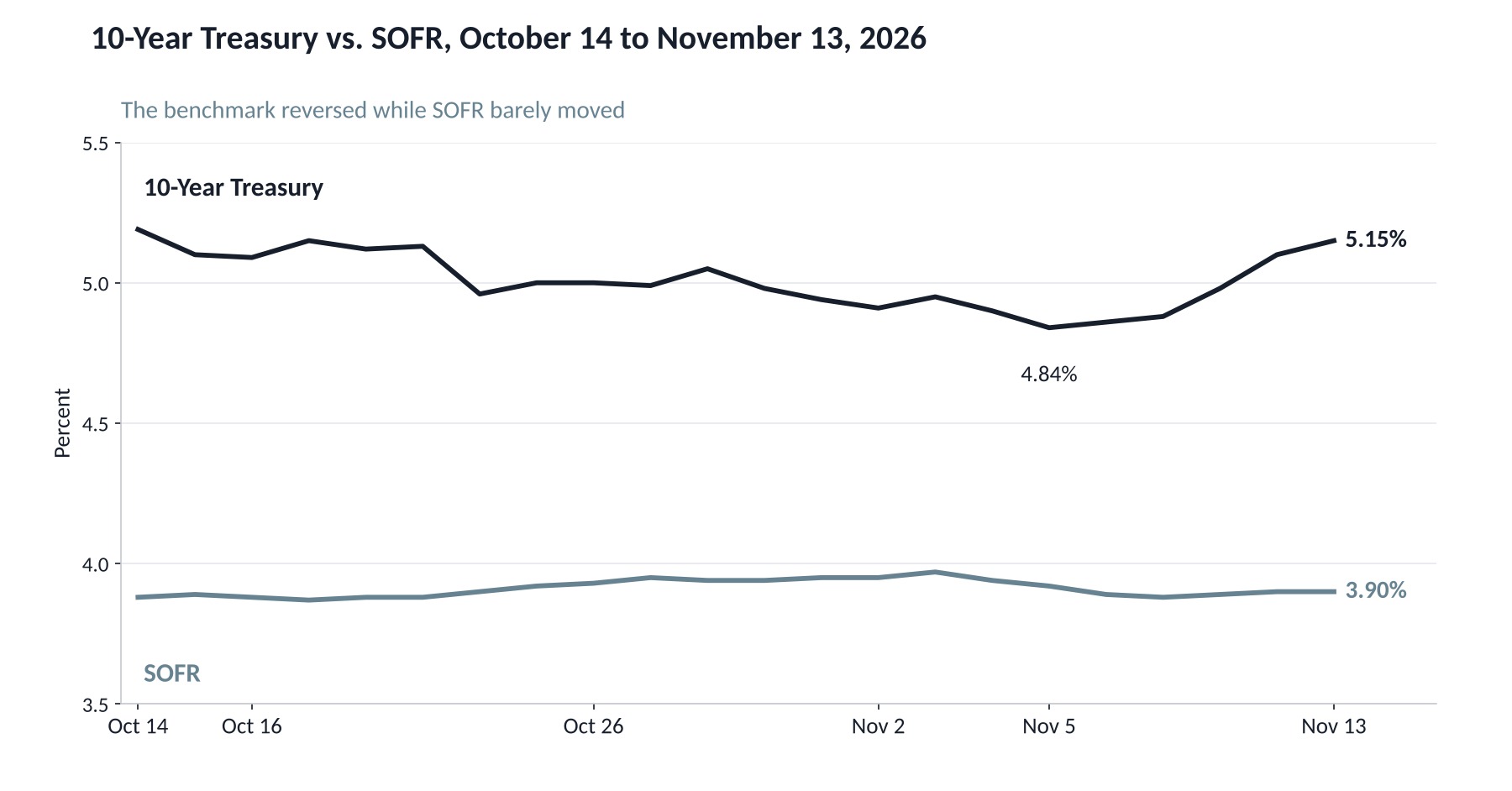
For CRE, the composition of this move matters more than its size. A front-end selloff reprices floating-rate debt, rate caps, and five-year executions most directly, which is where transitional and value-add capital sits.
Market Signals and Developments
Agency production is steady but subdued. Fannie Mae closed $14.5 billion of multifamily business in the third quarter and Freddie Mac closed $16 billion, down from $25 billion in the same quarter of 2025, a decline Freddie attributed to higher rates. By our estimate each enterprise has used roughly half of its $88 billion 2026 cap, so rates rather than allocation are holding volume back.
Securitization is moving in two directions. Private-label CMBS printed 10 deals in October against 19 in September as issuers waited out the Fed and the election. CRE CLO issuance, roughly three-quarters multifamily bridge collateral, is approaching its 2021 record. With up to 13 deals in the November pipeline, the conduit pause is a deferral rather than a closure.
Private credit is consolidating rather than retreating. Third-quarter debt fundraising was the weakest since 2021, yet established managers are closing above target, and alternative lenders took 48% of non-agency closings, up from 37% a year earlier.
Market Pricing Snapshot Table
| Capital Source | October 16, 2026 | November 2, 2026 | November 16, 2026 |
|---|---|---|---|
| Agencies (Fannie/Freddie) | 6.08%–6.78% | 5.92%–6.67% | 6.06%–6.80% |
| Life Companies (Multifamily) | 6.35%–7.60% | 6.17%–6.72% | 6.30%–6.85% |
| Life Companies (Commercial) | 6.39%–7.29% | 6.29%–7.22% | 6.45%–7.35% |
| Banks (Fixed) | 6.07%–7.07% (est.) | 5.87%–6.87% (est.) | 6.14%–7.14% (est.) |
| Debt Funds / Bridge (Floating) | 275–375 bps + SOFR (est.) | 275–375 bps + SOFR (est.) | 275–375 bps + SOFR (est.) |
| CMBS Conduit | 6.96%–7.44% | 6.74%–7.27% | 6.90%–7.40% |
All rates are informational and subject to change.
Capital Source Activity
Agencies (Fannie Mae and Freddie Mac)
Ten-year agency executions price from roughly 6.06% to 6.80%, at spreads of about 90 to 165 bps depending on leverage. Both enterprises have cap room, while underwriting has hardened in pockets such as rent-regulated New York assets.
Life Companies
Life companies are the most aggressive spread competitors in the market, holding spreads steady as the 10-Year rose and lifting their share of non-agency closings to 20%. Office is the exception, where spreads are drifting wider.
Banks
Banks tightened standards across construction, multifamily, and nonfarm nonresidential lending in the October Senior Loan Officer Survey and reported weaker demand in all three. Their activity centers on relationship business and short-duration multifamily bridge loans, often with deposit requirements.
Debt Funds and Private Credit
Debt funds remain the primary source for transitional assets, with our estimated bridge range holding at 275 to 375 bps over SOFR for quality sponsors. Proceeds are the pressure point, as lenders underwrite to a higher-for-longer rate path and rising SOFR expectations lift rate cap costs.
CMBS Conduit & CRE CLOs
Conduit AAA spreads held near 83 bps over Treasuries in October, while BBB- spreads widened by about 60 bps since early September as subordinate investors priced more credit risk. CRE CLO execution remains efficient, which keeps multifamily bridge capital plentiful.
Asset Class & Buyer/Seller Sentiment
Multifamily
Fundamentals are stabilizing, with absorption nearly matching new supply. Credit is moving the other way: CMBS multifamily delinquency reached 8.09% and special servicing rose 69 bps in a month as fully extended bridge loans mature. Lenders want stabilized product and have little patience for troubled loans.
Industrial
Industrial remains the preferred collateral class, with third-quarter net absorption the strongest since 2022 and CMBS delinquency near 1.1%. Core distribution product draws full competition, while outdoor storage faces heavier stress testing.
Office
Office vacancy declined for a fifth consecutive quarter, yet office CMBS delinquency rose to 12.33%. Capital is available for well-leased assets and recapitalizations, while commodity office still needs fresh equity to close refinance gaps.
Hospitality
Hotel operations are strong, with third-quarter RevPAR up about 7%, yet lodging made up 37% of October special servicing transfers. Most November hotel maturities carry debt yields below 6%, a level that does not size at today’s coupons.
Interpretation of Lender Behavior and Capital Conditions
We classify the current environment as Relief Revoked: a Benchmark Volatility Phase now led by the front end of the curve, with Refinance Pressure Cycle conditions intact and early Credit Tightening characteristics at the margin. The regime evolves from November 2’s Provisional Relief rather than breaking from it. We called that relief benchmark-driven and therefore reversible; the reversal arrived through the same channel, with spreads stable in both directions.
The behavioral logic is consistent. At 5% benchmarks, a low-leverage, stabilized loan offers lenders an attractive all-in yield with little credit risk, so they compete on spread to win it. At the same coupons, a marginal loan fails coverage tests and refinance math, so lenders reduce proceeds, decline extensions, and demand more equity. The result is a market that is crowded at the top and thin at the margin.
Implications for Borrowers and Investors
For stabilized borrowers, spread competition is the most valuable lever available, and it is underused. Benchmarks will move on inflation data and the December decision, but a competitive process still moves pricing on quality assets, and rate lock timing deserves the same discipline as lender selection.
For transitional borrowers, the risk has shifted from the 10-Year to SOFR. A floating-rate plan underwritten to a falling rate path now faces a rising one, with higher cap costs, tighter coverage, and extension tests that lenders are less willing to waive. Recapitalization planning should begin well before the extension window.
What This Means If You Are…
A Bridge Borrower with a 2027 Maturity: Rebuild your exit model on a SOFR path near 4.5% to 4.8%, not today’s 3.90%, and price replacement rate caps now. If the refinance does not size, begin the recapitalization conversation this quarter while you still control the timeline.
A Stabilized Owner Weighing a Fixed-Rate Refinance: Run a full competitive process across agencies, life companies, and banks, because spreads are negotiable even when benchmarks are not. Agree on a rate lock strategy before December 9 rather than reacting to it.
An Investor Seeking Acquisitions: Distress is concentrating in hotels and fully extended multifamily bridge loans, where lenders are less willing to extend and more willing to transact. Arrive with committed equity and financing certainty, because sellers in this cycle are choosing certainty over price.
Closing Reflection
Capital has remained available throughout 2026 for borrowers who meet the market where it is. Benchmarks now move 25 to 30 bps in a week on a single inflation print, and the policy path points higher for the first time since 2023. The participants who perform best in this environment will be those who treat spread, structure, and timing as separate decisions, secure the competition that strong collateral still commands, and address weak capital stacks before the market addresses them on its own terms.